

A good family vacation comes down to decisions made in the right order: what everyone wants, what you can spend, when to go, and which bookings to lock first. Most of the stress comes from doing them out of order, or from coordinating flights, rooms, transfers and tickets for several people at once. You can do all of it yourself. If your trip is a Disney week, a cruise out of Galveston, an all-inclusive resort or a multi-family reunion, a travel advisor can take the research and the coordination off your plate. At Point Me To Paradise Travel, we handle the research, accommodations, flights, transfers, activities and travel documents. Below is the full routine, step by step, so you can see where the time goes.
TL;DR
- Hold one short family meeting a few weeks before booking and write down four decisions: place and dates, one pick per person, packing jobs, and trip rules.
- Set the budget before the destination. Experts quoted by WalletHub suggest 5% to 10% of household income, then pad it for fees, parking and tips.
- Book in order of what sells out first: lodging, then flights, then tickets, dining and activities. Peak-season trips need four to twelve months of lead time.
- Give kids real choices, and plan one main activity a day with room for downtime.
- Complex trips (Disney, cruises, groups, international) are where an advisor saves the most hours and mistakes.
Table of Contents
- Step 1: Agree on what the trip is for
- Step 2: Set a budget that survives contact with reality
- Step 3: Choose a destination and dates your whole family can enjoy
- Step 4: Book in the right order, and early enough
- Step 5: Pick lodging that fits your family
- Step 6: Let the kids help, then protect the downtime
- Step 7: Get ready to leave
- When to plan it yourself and when to bring in an advisor
- Plan your family trip with Point Me To Paradise
- FAQ
- Sources
Step 1: Agree on what the trip is for
The most common way a family vacation goes wrong is that nobody asked what each person wanted. Parents choose a destination, a teenager wants a pool and Wi-Fi, a grandparent can’t manage long walks, and the disagreement shows up on day two.
Fix it with a short meeting before you book. A family vacation meeting agenda from TaskFamily suggests holding it a few weeks before booking, with one parent leading and the other taking notes. Everyone, including the children, names one thing they hope to do, written down without editing. You end with four decisions on one sheet: place and dates, one thing each person chooses, packing jobs, and trip rules. For children from about age 4, it recommends giving real two-option choices, such as window or aisle seat, rather than open-ended questions.
If you are planning with extended family, borrow from the professionals. AARP’s multigenerational travel tips describe a planner who starts with an online survey to surface needs early, such as a relative who can’t fly for medical reasons, and another who asks every client what would make the trip completely memorable and what would ruin it. Asking “what would ruin this vacation for you?” gets honest answers fast, and it gives everyone a voice before anyone is disappointed.
Kiplinger’s family vacation guide adds the practical layer for bigger groups: start with a joint video call, agree on who pays for what and how shared costs are split, collect date preferences and a short list of destinations, and assign responsibilities with deadlines.
What an advisor adds here
A meeting gives you preferences. Turning them into a trip that fits is the hard part. In our consultation-based planning process, you tell us who is traveling and what matters, and we do the research against that list. For multi-family trips, our guide to planning a group trip for families or friends shows how that works.
Step 2: Set a budget that survives contact with reality
Decide the number before you fall in love with a place. WalletHub’s budget family travel guide reports that most financial experts it cites recommend setting aside 5% to 10% of household income for a family vacation, which works out to roughly $4,000 to $8,000 on an $80,000 income.
For a sense of scale, one MoneyLion study of 20 US destinations priced a week for a family of four using August 2 to 9 dates and data from May 6, 2026. Gettysburg, Pennsylvania came out cheapest at $3,206 for the week, while Orlando came to $4,167 and San Antonio to $4,141. Those totals include meals, hotels and airfare, and they shift with season and fares, so treat them as a way to compare destinations rather than a quote for your own trip.
A budget that stops at airfare and a room is not a budget. Add these before you commit:
- Taxes, resort fees and baggage fees
- Parking and airport transfers
- Meals, snacks and tips
- Park tickets, excursions and tours
- Travel insurance and travel documents
- A reserve for schedule changes or a missed connection
Then pad the total. Resort fees, parking, drinks and souvenirs rarely appear on a booking confirmation, and a 10% cushion keeps a good week from turning into an argument about money.
Where an advisor helps with cost
We offer agency-exclusive deals, and in many cases a low-price guarantee or price matching. We also lay out what is included in a package, so transfers, meals and activities are in the plan from the start rather than discovered at checkout.
Step 3: Choose a destination and dates your whole family can enjoy
Narrow your list to two or three places, then compare each on four questions: does it fit the budget, does it fit the time you have, does it suit every traveler, and does it match the goal you wrote down in step 1?
The “every traveler” question matters most with a wide age range. Match the place to your youngest and oldest travelers. A toddler may struggle with long drives and packed transit days, while a teenager needs something to do. A Caribbean all-inclusive and a national-park loop can cost the same and give you completely different weeks.
The patterns we see families choose most often:
- Theme parks. Disney World suits families who want a structured week with dining, character meetings and on-property hotels. Our Disney travel agency team plans these trips.
- Cruises. One price covers transportation, lodging and meals, and kids’ programs keep different ages busy. Sailing from Galveston means no flight for many Texas families. See our cruise vacation packages.
- All-inclusive beach resorts. Food, drinks and activities are in one price, which makes budgeting simpler. Our Caribbean travel agency page covers options.
- Road trips and national parks. Lowest cost, most flexible, but lodging near the parks can fill early.
For dates, check school calendars and work schedules first, then weigh season, crowds and price. Shoulder seasons, the weeks just before or after peak, often give you lighter crowds and lower rates without losing much of the good weather.
Step 4: Book in the right order, and early enough
How far ahead you plan depends on the trip, but the order stays the same: whatever sells out first goes first. For most families that means lodging, then flights, then tickets, dining and activities.
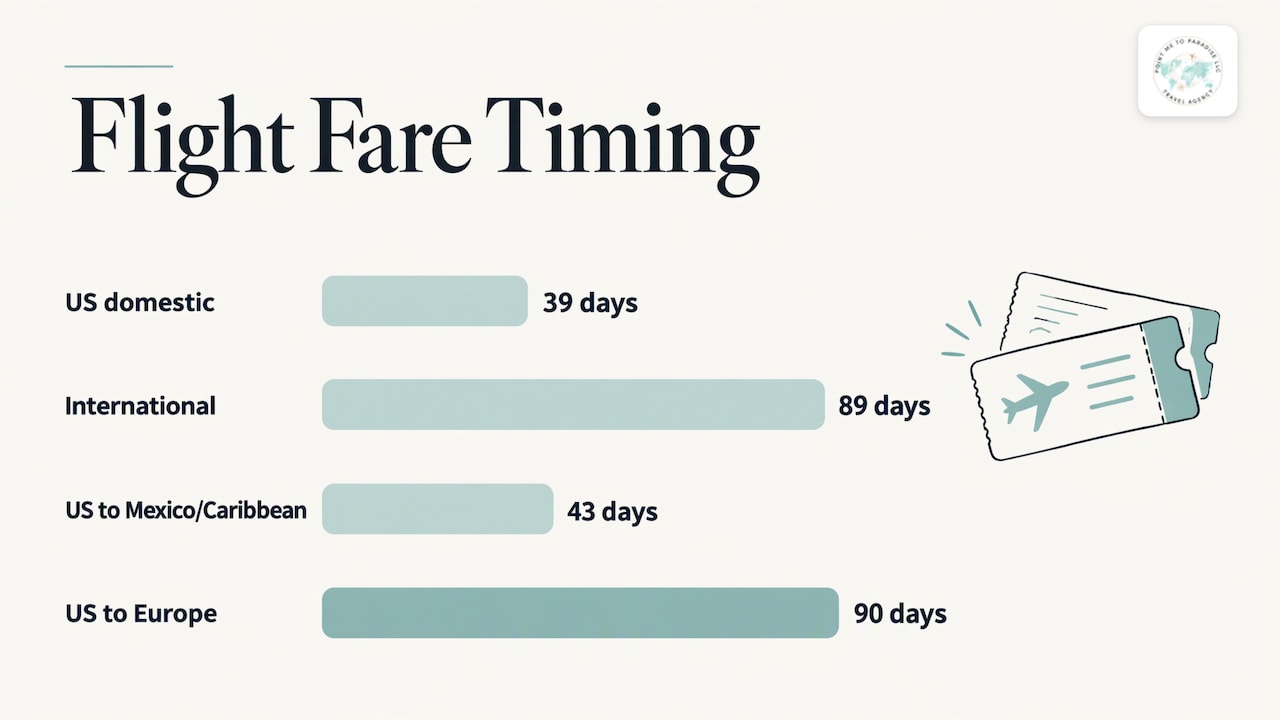
For flights, there is real data. According to Forbes Advisor’s summary of Google’s 2026 flight study, US domestic fares bottomed out about 39 days before departure, international fares about 89 days out, US to Mexico and the Caribbean about 43 days out, and US to Europe about 90 days out. Those are averages, and peak weeks like spring break, summer and holidays behave differently, so families who travel then usually book earlier.
Here is a practical sequence for a peak-season trip, based on the timelines in the research:
| When | What to do |
|---|---|
| 9 to 12 months out | Pick destination and dates, set the budget, and book resort or rental for school breaks, summer and December holidays |
| 6 to 8 months out | Book flights and rental car, and check every traveler’s passport |
| 4 to 5 months out | Book park tickets, tours and dining |
| 2 to 3 months out | Arrange pet care, build the daily itinerary, request time off |
| 1 month out | Reconfirm every reservation |
| 1 to 2 weeks out | Pack and run final checks |
This schedule follows a 12-month family planning timeline published by a vacation rental company, which also notes that popular activities can sell out three to six months ahead. Treat the early end as the safe end for school-break weeks and the later end as workable for off-peak and domestic trips. A trip that is domestic and off-peak can often be planned in two to three months.
A tool that keeps the dates, confirmations and shared decisions in one place helps with the sequence. A group vacation planning guide covers the collaborative side of this for larger parties.
The step where an advisor earns the most
This is the stretch with the most moving parts: matching room types to your family size, timing flights to land with transfers, and holding the bookings together so one change doesn’t break the rest. Our advisors handle accommodations, flights, transfers, activities and travel documentation, then give you a custom trip website or app so your itinerary and details live in one place. If something shifts mid-trip, we offer 24/7 support.
Step 5: Pick lodging that fits your family
The room matters more with kids than with any other kind of traveler. Before you book, confirm:
- Sleeping arrangements. Bed sizes, sofa beds, rollaways, cribs, bunk beds, connecting rooms and occupancy limits. “Sleeps six” doesn’t always mean six comfortable beds.
- Room size and layout. A suite with a door between sleeping areas can be the difference between bedtime and chaos.
- Location. Walking distance to the beach, park or attractions saves a rental car and a lot of cranky transit time.
- Family amenities. Pools, kitchens, laundry, elevators, cribs and high chairs for little ones.
- Total cost. Resort fees, parking, cleaning charges and deposits.
These checks track the guidance in Our Family Travel’s lodging checklist. Resort stays, suites with extra space and vacation rentals each suit a different family size and budget. Families with babies and toddlers often prioritize a washer and dryer, while larger families often prefer a rental with a kitchen and pool.
With several households traveling together, lodging is the hardest piece, because everyone needs space and a shared gathering spot. Booking a block of cabins on one cruise ship or rooms at one resort is often simpler than assembling separate reservations. Our group cruise booking page explains how that works.
Step 6: Let the kids help, then protect the downtime
Children who helped plan the trip are more invested in it. PBS KIDS for Parents suggests letting kids mark the travel dates on a calendar, look at a map of the route, research weather and attractions, and make their own packing lists. A Hilton survey of about 13,000 traveling adults reported by Parents found that 70% of adults who travel with kids choose the destination based on their children’s needs and interests.
Give choices that are real but bounded. Offer two breakfast spots, two excursions, or a pool morning versus a museum morning. A younger child can choose between two options, and an older child can plan an afternoon.
Then resist the urge to fill every hour. The same Parents report found that 54% of parents carve out adult time during family getaways. Plan one main activity per day, add a couple of optional extras, and leave open stretches for the pool, a nap or nothing at all. Let each child take a turn choosing the day’s activity, so no one feels the trip belongs to someone else.

Step 7: Get ready to leave
The last month is about confirmations and logistics:
- Passports and IDs. Check every traveler’s expiration date as soon as you pick an international destination, well before flights are booked, since renewals take time.
- Reconfirm everything. Flights, hotels, transfers, tickets and dining reservations, one month out.
- Pets and home. Arrange pet care, stop the mail and set up lights or a house-sitter.
- Insurance. Decide on travel insurance when you make the first non-refundable payment, not the week before you leave.
- Pack together. Divide jobs according to the sheet from your family meeting. Pack medications and one change of clothes for each child in carry-on bags.
- Check in a week out. A 10-minute family check-in the week before leaving catches forgotten details and gets kids excited.
When to plan it yourself and when to bring in an advisor
A weekend road trip needs a spreadsheet and a few phone calls. A week at Disney World, a cruise with three generations, an international resort stay or a reunion for twenty-five people is a different job. Dining windows, room categories, flight timing, transfers and documents all interact, and a mistake in one costs money in another.
That is the kind of trip where a specialist pays for themselves in hours saved and surprises avoided. Our travel advisors bring destination expertise, take on the research and bookings, and stay reachable around the clock once you travel. You still make every decision that matters, from the destination to the room. We take care of the pieces that eat your evenings.
Plan your family trip with Point Me To Paradise
If you are planning a cruise from Galveston, a Disney vacation, an all-inclusive beach week or a trip with several families, we can build it with you. We start with a consultation about your family and your goals, then handle the research, accommodations, flights, transfers, activities and travel documents. You get a custom trip website or app that keeps your itinerary in one place. Start at our travel planning page and tell us who is coming.

Prefer a particular kind of trip? Our team also plans Disney vacations, cruises and Caribbean getaways.
FAQ
How far in advance should you plan a family vacation?
For a domestic, off-peak trip, two to three months is often enough. For school breaks, summer, holidays, Disney or international travel, plan four to twelve months ahead, and book lodging first because it sells out before flights get expensive. Google’s 2026 flight study, as reported by Forbes Advisor, found fares tend to bottom out roughly 39 days out domestically and 89 days out internationally.
What is a good budget for a family vacation?
Experts cited by WalletHub recommend setting aside 5% to 10% of household income, about $4,000 to $8,000 on an $80,000 income. Then add a cushion of roughly 10% for fees, parking, tips and souvenirs that don’t show up on booking confirmations.
How much does a family vacation cost for a family of four?
It depends heavily on the destination, the season and the length of stay. In MoneyLion’s study of 20 US destinations (data as of May 6, 2026, for an August week), totals ranged from $3,206 in Gettysburg to $4,167 in Orlando. Cruises, Hawaii and international trips can cost considerably more, so price your specific plan rather than relying on a national average.
How do you plan a trip with kids who want different things?
Hold a short family meeting, let each person name one thing they hope to do, and write the choices down. Give younger children two-option choices, give older children a block of the schedule to design, and plan one main activity per day with downtime in between.
Is it worth using a travel advisor for a family trip?
It is most useful on trips with many connected pieces: Disney, cruises, resorts abroad, destination events and multi-family groups. We coordinate accommodations, flights, transfers, activities and documentation, and provide 24/7 support during your trip.
Sources
- Family vacation meeting: a 28-minute agenda (TaskFamily)
- Tips to Create a Harmonious Multigenerational Trip (AARP)
- 6 Family Vacations for Every Generation (Kiplinger)
- 10 Budget Family Travel Tips (WalletHub)
- How Much a Weeklong Family Vacation Costs in the U.S. Now (MoneyLion)
- Best Day and Time to Book Flights (Forbes Advisor)
- Family Vacation Planning Timeline, 12 Months Out (Rialto)
- Family Vacation Planner (Our Family Travel)
- Planning a Trip? Let Your Child Help (PBS KIDS for Parents)
- Gen Alpha Kids Are Making Some Big Travel Decisions (Parents)