
Corporate incentive travel is a trip a company pays for to reward people who hit a defined goal: top sellers, high-performing teams, channel partners or nominated employees. It works when the goal, the qualification rules and the destination are settled before anyone books a flight. It fails when logistics eat the planning time. At Point Me To Paradise, our advisors handle the research, accommodations, flights, transfers, activities and travel documentation for group and incentive trips, so your team can focus on the program itself.
This guide covers what an incentive trip is for, the budget, how to set qualification rules, how to choose a destination, how to measure results and what to hand to a travel agency.
TL;DR
- Incentive travel exists to motivate: the Society for Incentive Travel Excellence (SITE) separates it from meetings, which inform, and says the destination’s appeal has to trigger the motivation.
- Budget for the whole trip. Reported US spend runs from $4,000 to $6,000 per attendee, up to $25,000 for the most lavish programs.
- Write simple, transparent, goal-based qualification rules before launch. Research links them to better program results.
- Pick a destination on appeal, infrastructure and safety first, then on cost. Closer-to-home and all-inclusive options are growing.
- Measure against a baseline taken before the program starts, and let an agency carry the logistics for you.
Table of Contents
- What corporate incentive travel is for
- What a company incentive trip costs
- Types of incentive programs
- How to set qualification rules
- Choosing the destination
- Planning the trip itself
- What a travel agency takes off your plate
- Ready to plan your company’s incentive trip
- Measuring whether it worked
- FAQ
- Sources
What corporate incentive travel is for
SITE describes incentive travel as a business tool to reward and unlock human potential to achieve corporate objectives. The objectives it lists include more sales, better morale and loyalty, market share, teamwork and better customer service. The same page draws a useful line: a corporate meeting informs or educates, while an incentive trip motivates and inspires. That means the trip is judged by whether people want it enough to change their behavior, not by how smooth the agenda is.
Research from the Incentive Research Federation (IRF), reported in Sales & Marketing magazine in October 2026, ranks increased sales revenue as the top business objective of incentive travel campaigns. Next come morale, engagement and recognition, then retaining top performers, organizational alignment, and productivity.
The practice is established. A 2014 IRF report cited by Condé Nast Traveler found US businesses had spent over $22 billion on incentive travel, and 46% of surveyed companies used it to reward top performers, with sales programs using it most.
Why travel and not cash
Cash is popular. An IRF survey of 1,500 US full-time employees found 88% put cash bonuses in their top three annual rewards, and 38% put an incentive trip for themselves or a companion there. The trip still has a job cash cannot do: it is a shared, memorable event with a story attached. An IRF white paper based on 137 manager responses found non-cash programs were more often linked to retention, satisfaction and performance than cash programs, for example 29.2% versus 21.9% for retention.
SITE also notes that the award usually covers a qualifier plus a significant other. The guest becomes a performance catalyst at home, because someone close to the employee is rooting for the goal.
What a company incentive trip costs
Per Condé Nast Traveler, companies typically spend between $4,000 and $6,000 per attendee, and the most lavish programs reach $25,000 a head. The same article reports the IRF’s claim that well-designed programs can lift sales productivity by 18% and return 112% on investment. Treat those as reference points for planning conversations, not guarantees. Your own baseline matters more, as the measurement section below explains.
A worked example makes the budget concrete. Suppose 40 qualifiers each bring a guest, so 80 travelers. At $5,000 per traveler, the base is $400,000. That figure is a planning assumption inside the reported range, not a quote. The line items to price for each traveler are:
- Flights and ground transfers
- Lodging and any venue fees
- Meals and hosted events
- Activities and excursions
- Travel insurance and a contingency reserve
- Staffing and supplier fees
- Accessibility needs
Ask your finance or tax adviser how the award is treated for payroll and taxes before you announce it. Employees need to know early whether the trip carries a tax cost to them, because a surprise there undoes the goodwill the trip was meant to build.
Types of incentive programs
Most programs fall into one of four shapes:
| Program type | Who it rewards | Typical measure |
|---|---|---|
| Sales incentive | Sellers and channel partners | Revenue, pipeline, new accounts, quota |
| Performance-based | Operations, service, support | Productivity, quality, customer satisfaction |
| Recognition | Nominated employees | Leadership, innovation, safety |
| Team-wide | Whole company or department | A shared company goal |
Real examples show the range. According to Northstar Meetings Group’s 2024 Motivation Masters Awards, ShipBob took its top 15% of departments, those earning at least 100% of goals, to a resort weekend in Los Cabos, Mexico, and qualifiers rose 21% over 2023. T-Mobile flew its 200 peer-nominated top employees plus a guest to Maui for five days.
Not every program needs a flight to Hawaii. Smaller companies run a three-day regional getaway for a dozen top performers, or a cruise for a department. Our guide to how group cruise booking works explains the group side of that option.
How to set qualification rules
The rules decide whether the trip motivates or demoralizes. An IRF and University of Central Florida study describes earning criteria as the specific rules participants must meet to win the trip. Its case example allocated each division about 10% of eligible employees as potential earners, 100 of 1,000. Employees typically needed six months with the company. Two tests applied at once: meet every stated criterion and rank high enough to secure a place. The researchers’ point is that correct criteria align effort with business objectives and remove doubt about what level of performance earns the reward.
The IRF’s 2026 European Top Performers study gives a useful pattern, although it surveys European companies. Top-performing companies qualified a smaller share of participants but gave trips with nearly 1.5 times the reward value. They were more likely to use:
- Automatic qualification on pre-defined goals: 70%, against 30% of comparators.
- Simple, clear rules: 71%, against 26%.
- Special rules that give new participants a better chance: 74%, against 26%.
The same study found top performers qualify on financial metrics (80%), activity metrics such as sales calls and CRM tracking (79%), and customer relationship metrics (70%).
Keep recognition programs transparent
If winners are nominated rather than ranked, fairness is the risk. An IRF case study of a nomination-based program, drawing on nearly 200 interviews and 256 survey responses, found the process should be easy to start, and the selection transparent enough that non-winners see winners as deserving. It also recommends a policy on repeat winners so the program stays fair.
A short checklist before launch:
- Name the one business goal the trip serves.
- Convert it into a number people can track themselves.
- Publish the cutoff date, headcount and guest policy.
- Add a path for new hires so they can compete.
- Decide how ties and repeat winners are handled.
Choosing the destination
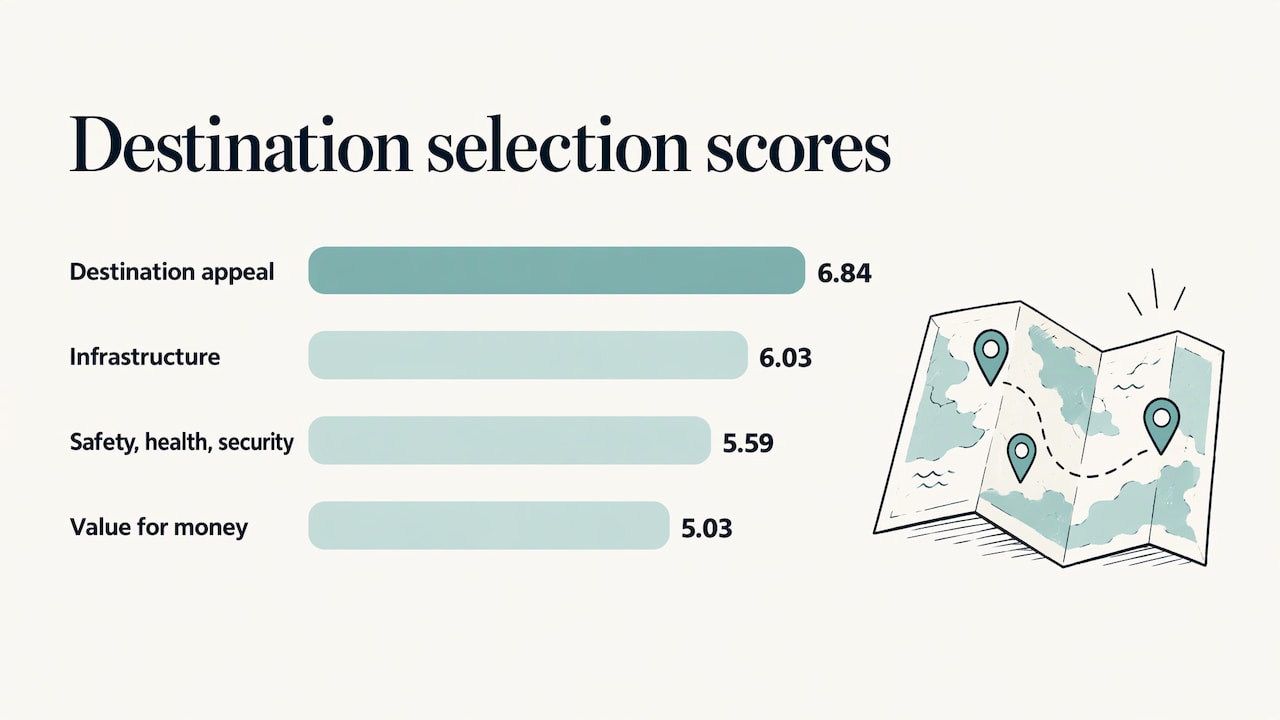
The destination is where the motivation is won or lost, because the appeal has to make people want to qualify. SITE’s Destination InSites survey, reported in Sales & Marketing’s October 2025 focus report, ranks destination appeal (6.84), infrastructure (6.03) and safety, health and security (5.59) as the top selection factors. Value for money scored 5.03. The report adds that budgets have pushed more groups toward all-inclusive resorts, and that in the US and Europe companies are keeping groups closer to home.
Planners are also widening the map. The Meeting Magazines (October 2025) describes shortlists with Santa Fe, Cabo, Monterey and Nashville, a budget-friendly fall incentive in Maui during the slower season, and advice to alternate between beach, mountain and desert settings from year to year so repeat qualifiers see something new.
Match the place to the people:
- Sales teams that love a prize: a beach or resort setting with a clear sense of luxury, such as Hawaii or the Caribbean.
- Mixed-age, partner-inclusive groups: a cruise gives every guest a different day while the group still shares dinners and events.
- Repeat qualifiers: an experience they cannot easily recreate on their own, from unique travel experiences to a small-ship itinerary.
- Tight budgets: an all-inclusive resort fixes most per-person costs up front.
Because we are based in the Galveston area, Texas companies can also look at cruises sailing from Galveston, which removes airfare from the budget for many travelers. Our Caribbean specialists cover resort and cruise options in that region.
Planning the trip itself
Balance structure with free time. Qualifiers have earned a break, so one hosted dinner and one group activity a day is plenty. Communicate early: eligibility, the guest policy, the dates and the destination should all be announced when the program launches, because the destination is part of the motivation.
The work is in the details: room blocks, flights from several home cities, transfers, activities, passports and entry documents, dietary needs, accessibility, and a plan for the guest who misses a connection. Multiply that by dozens of travelers and it becomes a second job for whoever in HR or sales operations got the assignment.
What a travel agency takes off your plate
This is the part we do every day. For incentive and group trips, our advisors handle research, accommodations, flights, transfers, activities, documentation and itinerary coordination. Travelers then receive a custom trip website or app, so the schedule, confirmations and details sit in one place rather than in a dozen email threads. Our advisors offer 24/7 support, agency-exclusive deals, and a low-price guarantee or price matching in many cases.
In practice that gives you:
- One point of contact instead of separate hotel, airline and tour negotiations.
- A single itinerary every qualifier and guest can open on their phone.
- Help when something changes mid-trip, at any hour.
- Your team’s time returned to running the incentive program: setting goals, tracking qualifiers and celebrating winners.
For group size and dates, a conversation early in the planning gives the best range of options, and our group trip planning guide shows how we approach shared travel.
Ready to plan your company’s incentive trip
If you are building a sales reward, a President’s Club or a corporate retreat, tell us the number of qualifiers, the likely season and the kind of experience you want to offer. We will return with destination options and a custom itinerary. Start with our group and custom trip planning.
Measuring whether it worked
Decide how you will judge the trip before you launch it. The IRF’s intangible-value white paper found the most common way to measure softer value is to track engagement and satisfaction surveys before, during and after the program. It also notes engagement gains tend to show up in sales and financial results with about a three-month lag, so do not judge the program on the week after the trip.
A simple scorecard:
- Baseline: record sales, engagement, retention and absenteeism at launch.
- During: track the qualifier count and participation. ShipBob’s 21% rise in qualifiers is the kind of signal to watch.
- After: survey attendees on arrangements, pacing and whether the reward felt motivating.
- Three months later: compare results with the baseline and against the trip cost.
SITE’s Canada insights paper from October 2025 adds that companies mix formal metrics such as NPS and post-event surveys with leadership debriefs. Prestige events like a President’s Club sometimes lean on emotional resonance instead of formal measurement.
FAQ
What is the purpose of incentive travel?
It rewards and motivates people to reach a business goal, most often higher sales, and it also supports morale, retention and teamwork. SITE distinguishes it from a meeting because its job is to inspire rather than inform.
How much do company incentive trips cost per person?
Reported spending is typically between $4,000 and $6,000 per attendee, with the most lavish programs reaching $25,000, according to Condé Nast Traveler. Include flights, lodging, meals, activities, insurance and a contingency reserve. If guests travel too, count them as attendees.
Who should qualify for an employee incentive trip?
The people who reach a clear, published goal. Research suggests simple rules, automatic qualification on pre-set targets and a path for newer employees. For nomination-based programs, publish the selection process so non-winners can see it is fair.
What are examples of team reward travel?
Examples include a resort weekend for departments that hit their goals, a five-day trip to Maui for nominated top employees with a guest, or a cruise for a team. The right choice depends on your headcount, budget and the kind of experience your people value.
Sources
- What is Incentive Travel, SITE Global
- Reward Preferences white paper, IRF (2020)
- In Pursuit of Elusive Metrics Around Incentive Travel Events, Sales & Marketing
- The Extravagant Rise of the Corporate Incentive Trip, Condé Nast Traveler
- Establishing the Intangible, IRF (2018)
- Meet the 2024 Motivation Masters Awards Winners, Northstar Meetings Group
- Anatomy of a Successful Incentive Travel Program, IRF
- 2026 European Top Performers Study, IRF
- Critical Findings for Recognition Travel Programs, IRF (2011)
- A New Era of Incentive, Sales & Marketing focus report (October 2025)
- Great Escapes; Creating Bespoke Incentives, The Meeting Magazines
- Beyond Reward & Recognition, SITE Destination Canada insights